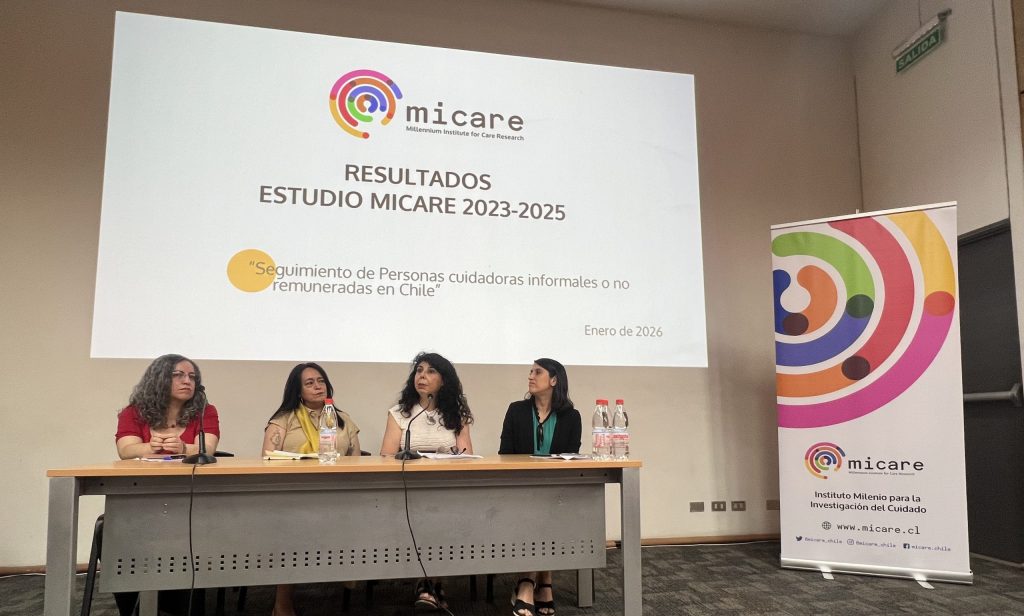
MICARE held a seminar entitled “Advances and lessons learned in measuring care. Experiences in light of the MICARE longitudinal study”, which provided an opportunity to share recent evidence and reflect on the challenges of measuring care in Chile and Latin America.
The event took place on Wednesday, January 14, 2026, in the Auditorium of the UC Faculty of Education, and was opened by Claudia Miranda, director of MICARE and professor at the Andrés Bello University Faculty of Nursing, who highlighted the importance of longitudinal evidence for understanding care trajectories and guiding public policy decision-making.
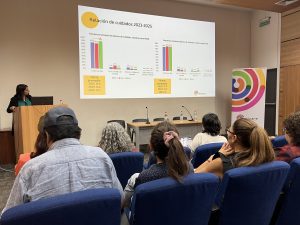
During the seminar, Beatriz Fernández, academic at the UC Institute of Sociology and principal investigator at MICARE, presented the results of the MICARE Longitudinal Survey, corresponding to the analysis of three waves of the study, addressing the main findings regarding the experience of caregivers, the evolution of overload, and the inequalities associated with caregiving.
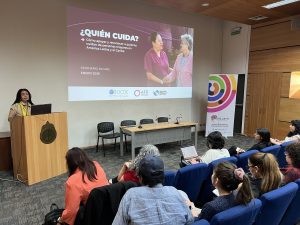
Subsequently, Patricia Jara, Chile specialist at the Social Protection and Health Division of the Inter-American Development Bank (IDB), spoke about policies and good practices to support paid and unpaid caregivers and the care system in Latin America, placing the results of the MICARE study in a regional and comparative context.
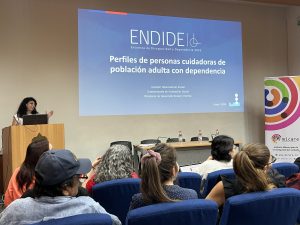
The seminar continued with a presentation by Maritza España, a professional from the Social Observatory Division of the Ministry of Social Development and Family, who addressed the main instruments for measuring care, highlighting key guidelines for the formulation of evidence-based public policies, programs, and intervention models.
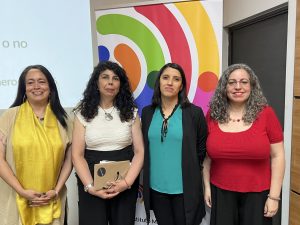
The day concluded with a panel discussion, moderated by Claudia Miranda, which invited reflection from diagnosis to action, highlighting the challenges of translating evidence into concrete decisions to strengthen the care system.
The MICARE study thus provides key inputs for the design and implementation of the new care institutional framework, underscoring the need for policies that accompany the changes that caregivers experience over time and that recognize both the increase in dependency in old age and the processes of autonomy in intellectual disability.
Main results MICARE study (summary)
- 76.3% of those who care for dependent older adults are women; the figure rises to 93.3% for the care of people with DID.
- More than 90% provide care every day, for an average of 15 to 16 hours, and nearly 90% live with the person they care for.
- In the care of older adults, overload increases by 3.9 percentage points and loneliness increases by 8 points between 2023 and 2025.
- In the care of people with DID, overload decreases by 9 points, although a significant group continues to experience high levels of stress.
- More than half of caregivers are outside the labor market, and 12% had to leave their jobs due to lack of support or relief.
To learn more about the study’s findings, please see: